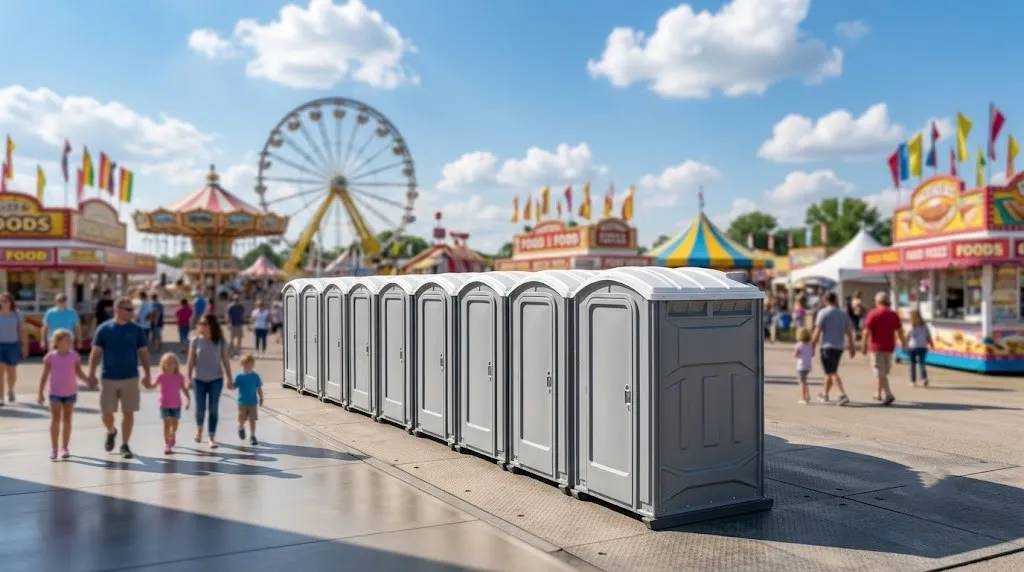
A county fair pulling a few thousand people a day needs one standard portable toilet per roughly 50 to 75 guests, plus at least one ADA unit per ADA Standards section 213.2. Joliet Porta Pros builds the count around your gate estimate and your fair's footprint, not a guess.
Start with attendance, not gut feeling. OSHA 1926.51(c) sets construction-site ratios, but fairs run on foot traffic density instead, so most operators plan around one standard unit per 50 to 75 attendees at peak hour, then add units near food vendors, livestock barns, and grandstands where lines bottleneck. A fair expecting 3,000 people on a Saturday might need 40 to 60 standard porta potty rental units spread across the grounds, not clustered at one entrance. Joliet fairs often run multiple days, so servicing schedule matters as much as unit count. ANSI/PSAI Z4.3 sets a baseline of one service visit per week for steady low-use settings, but a fairground pushing thousands of uses a day needs daily servicing, sometimes twice, to keep tanks from topping out mid-event. We map your layout before quoting, factoring in event restroom rental standards and where crowds actually stand, not just where the fence line runs. If your fair sits close to Crest Hill or draws from Plainfield, 12.2 miles northwest, we account for that pull when sizing the order. Want a firm number before you call? Run your headcount through how many porta potties do i need first, then we refine it against your actual site map and vendor placement.
Every fair needs accessible units and handwashing, and neither is optional once the gates open. ADA Standards section 213.2 requires that where portable toilets are clustered, at least 5 percent be accessible, with a minimum of one unit regardless of total count. Our ada accessible porta potty units meet the section 304.3.1 turning circle spec of 60 inches and the section 404.2.3 door opening minimum of 32 inches, so wheelchair users and strollers both move through without a fight. Pair those with handwashing station rental units at food courts and livestock areas. 29 CFR 1910.141(d)(2) requires soap and a way to dry hands, not just sanitizer, which matters a lot near animal barns and funnel cake stands alike. If your fair has a beer garden or a painting demo booth, note that OSHA 1926.51(f)(1) washing requirements apply specifically to paints, coatings, herbicides or insecticides exposure, so any vendor using those needs washing access nearby, not just the general midway stations. We also place portable sink rental units where fair organizers want a step up from a hand sanitizer stand. For fairs drawing overflow crowds from Romeoville, 9.9 miles north, or New Lenox, 10.9 miles east, we plan handwash placement around the parking-to-gate walk, not just the fairground center.
Most fairs need more than restrooms: fencing, dumpsters, and often a restroom trailer for VIP or staff areas round out a full site plan. Temporary fence rental keeps midway crowds off equipment lines and livestock pens, and crowd control barrier rental works well for queue management at gates and grandstand entries. A standard chain-link run, priced by the day, handles most perimeter needs; see chain link temporary fence for specs. Waste adds up fast at a multi-day fair, food wrappers, livestock bedding, vendor packaging, so a roll-off dumpster rental sized to your event length matters. A 20 yard dumpster rental covers most single-day fairs; multi-day events with food vendors often need a 30 yard dumpster rental instead. Check what cannot go in a dumpster before loading in livestock waste or cooking oil, since grease needs separate handling, similar to how a grease trap pumping crew treats a grease interceptor once fats and solids reach 25 percent of liquid depth. For fair boards wanting an upgraded option for staff or judges, a luxury restroom trailer or 4 stall restroom trailer beats a bank of standard units for comfort. Joliet fairgrounds with tight loading areas should plan for the roll-off truck needing about 60 feet of straight clearance behind it, which changes where the dumpster can sit relative to vendor rows.
Book as soon as your date and headcount are set, ideally 60 to 90 days out for a multi-day fair. Popular fair weekends compete with weddings and festivals for the same portable restroom rental inventory, so early booking locks in ADA units and trailers before they're gone.
Yes. A 2 stall restroom trailer or larger works well for VIP sections, staff areas, or smaller fairs under a few hundred daily attendees. Larger fairs usually mix trailers for comfort zones with standard units for general midway coverage.
Cost depends on unit count, duration, and add-ons like handwashing stations or trailers. Multi-day fairs typically fall under event or weekend pricing tiers rather than daily rates. See porta potty rental cost for a breakdown by unit type and rental length.
Permit rules vary by site and event type, and placement in any public right of way needs confirming with the city. Check porta potty permit requirements before finalizing your layout, especially if restrooms sit near a road or public easement.
Daily servicing is standard for fairground traffic, sometimes twice a day near food courts and grandstands. See how often are porta potties cleaned for how service intervals scale with attendance and unit placement across the grounds.
Yes. Joliet Porta Pros delivers county fair restrooms across Joliet and the surrounding metro, with same-day and next-day drop-off available on most orders.
Pricing depends on the unit and how long you need it. See our cost breakdown and request a free quote for an exact figure.
Standard rentals include scheduled service — a pump-out, a clean, a restock and fresh deodorizer. Busy or hot-weather sites can be serviced more often.
Call now or request a free quote — clean units, on-time delivery, transparent pricing.